Amira

Twitter https://twitter.com/amishare Homepage http://bit.ly/rbpjXC Google+ http://bit.ly/uQRGSu
Literature-Inspired Quote Illustrations by Evan Robertson http://www.demilked.com/quote-i...
"New York-based graphic designer Evan Robertson takes the cleverest lines written by his favorite writers such as Oscar Wilde and Ernest Hemingway and turns them into brilliant literary posters. “I took little snippets of text and ideas from some of my favorite authors (with some notable exceptions that I’m saving), and let the words be a springboard for an illustration. The illustrations incorporate and interact with the text and hopefully add up to something that engages the mind as much as the eye.” - Amira
More Robertson's illustrations: http://www.etsy.com/shop... - Amira
John Cage Performs Water Walk on “I’ve Got a Secret” (1960) [video] http://www.openculture.com/2011...
"In 1952, John Cage composed his most controversial piece, 4′33,″ a four-and-a-half minute reflection on the sound of silence. Now fast forward eight years. It’s February, 1960, and we find the composer teaching his famous Experimental Composition courses at The New School in NYC, and paying a visit to the CBS game show “I’ve Got a Secret.” The TV show offered Cage something of a teachable moment, a chance to introduce the broader public to his brand of avant-garde music. Cage’s piece is called Water Walk (1959), and it’s all performed with unconventional instruments, save a grand piano. A water pitcher, iron pipe, goose call, bathtub, rubber duckie, and five unplugged radios — they all make the music. And the audience doesn’t quite know how to react, except with nervous laughter. It wasn’t particularly courteous. But, as one scholar has noted, it’s equally remarkable that prime time TV gave ten minutes of uninterrupted airtime to avant-garde music." ["Water Walk" starts at 5:35] - Amira
See also Sounds of Silence: John Cage’s 4’33″ performed by the BBC Symphony Orchestra http://ff.im/OzdqA John Cage's Norton Lectures, given at Harvard in 1989 [MP3] http://ff.im/WPK73 - Amira
Beauty | Stanford Encyclopedia of Philosophy || “Beauty is nature’s way of acting at a distance.” — Denis Dutton http://plato.stanford.edu/entries...
"The nature of beauty is one of the most enduring and controversial themes in Western philosophy, and is—with the nature of art—one of the two fundamental issues in philosophical aesthetics. Beauty has traditionally been counted among the ultimate values, with goodness, truth, and justice. It is a primary theme among ancient Greek, Hellenistic, and medieval philosophers, and was central to 18th and 19th-century thought, as represented in treatments by such thinkers as Shaftesbury, Hutcheson, Hume, Burke, Kant; Hegel, Schopenhauer, Hanslick, and Santayana. By the beginning of the twentieth century, beauty was in decline as a subject of philosophical inquiry, and also as a primary goal of the arts. However, the last decade has seen a revival of interest in the subject. This article will begin with a sketch of the debate over whether beauty is objective or subjective, which is perhaps the single most-prosecuted disagreement in the literature. It will proceed to set out some of the major approaches to or theories of beauty developed within Western philosophical and artistic traditions." - Amira
"Beauty is no quality in things themselves: It exists merely in the mind which contemplates them; and each mind perceives a different beauty. One person may even perceive deformity, where another is sensible of beauty; and every individual ought to acquiesce in his own sentiment, without pretending to regulate those of others." -- David Hume - Amira
"Beauty is pleasure regarded as the quality of a thing. … Beauty is a value, that is, it is not a perception of a matter of fact or of a relation: it is an emotion, an affection of our volitional and appreciative nature. An object cannot be beautiful if it can give pleasure to nobody: a beauty to which all men were forever indifferent is a contradiction in terms. … Beauty is therefore a positive value that is intrinsic; it is a pleasure." -- Santayana (1896) - Amira
Leave Art By Lorenzo Duran – Astonishing Art Work - http://www.graphicdesignblog.org/leave-a...
"There are multiple types of Artss in this world, al you need to do is to explore them with the passage of time. Similarly, I came across with an unusual kind of Arts which is crafted over leaves! To my surprise I found out that Lorenzo Duran (Spanish Artsiste) makes different kinds of crafts and Artss over pieces of leaves. His crafting ranges from Chinese Jianzhi to Spanish, Swiss and German Arts. (...) He washes the leaves and dries them out. After this he finely creates different kind of Arts over dried leaves." - Amira
Wow - Todd Hoff
ENCODE: The Encyclopedia of DNA Elements - study produces 'Google Maps' for human genome - http://www.youtube.com/watch...
"Over the last 10 years, an international team of 442 scientists have assailed 147 different types of cells with 24 types of experiments. Their goal: catalogue every letter (nucleotide) within the genome that does something. The results are published today in 30 papers across three different journals, and more." // "The NHGRI-funded project, dubbed ENCODE (Encyclopedia of DNA Elements), linked more than 80 percent of the human genome sequence to a specific biological function and mapped more than 4 million regulatory regions where proteins specifically interact with the DNA. Among other things, these findings refute past research suggesting that most of our genetic code is essentially useless. NHGRI program director, Elise Feingold, likened the ENCODE catalog to “Google Maps for the human genome.” Researchers can use the ENCODE maps to navigate through the chromosomes, genes, functional elements and individual nucleotides in the human genome just as Google Maps users can adjust settings such as magnification to view countries, states, cities, street names and even individual buildings. In the coming years, ENCODE plans to increase the depth of the catalog and develop new tools for more sophisticated analyses of the data." https://plus.google.com/u... - Amira
The data can be accessed through the ENCODE project portal: http://www.encodeproject.org/ENCODE... You can read more about the project here: http://www.genome.gov/27549810. See also: ENCODE: the rough guide to the human genome http://blogs.discovermagazine.com/notrock... - Amira
Hey, there's my house...er...protein! - Todd Hoff
wow! See also: Genome Brings Ancient Girl to Life -- complete picture of girl over 50,000 years old "In a stunning technical feat, an international team of scientists has sequenced the genome of an archaic Siberian girl 31 times over, using a new method that amplifies single strands of DNA. The sequencing is so complete that researchers have as sharp a picture of this ancient genome as they would of a living person's, revealing, for example that the girl had brown eyes, hair, and skin. (...) Everyone was shocked by the counts. That includes me." http://news.sciencemag.org/science... - Amira
Navigate a visual map of the world’s most competitive economies | World Economic Forum http://widgets.weforum.org/global-...
"The World Economic Forum defines competitiveness as the set of institutions, policies, and factors that determine the level of productivity of an economy." - Amira
Global Competitiveness http://www.weforum.org/issues... - Amira
The history of paintings from Rafael Sanzio to Sra Cecilia http://a6.sphotos.ak.fbcdn.net/hphotos... :-)
Jesus fresco 'destroyer' in Spain demands royalties: "The airline Ryanair is now even offering deals to the north-eastern Spanish city, encouraging tourists to see the fresco in the Sanctuary of Mercy Church in Borja." http://www.bbc.co.uk/news... - Amira
Cultural officials said she had the best intentions and hoped the piece could be properly restored. - avatar8
Found poetry -- a type of poetry created by taking words, phrases, and sometimes whole passages from other sources and reframing them as poetry http://aminotes.tumblr.com/post...
“Found poetry is a type of poetry created by taking words, phrases, and sometimes whole passages from other sources and reframing them as poetry by making changes in spacing and lines, or by adding or deleting text, thus imparting new meaning. The resulting poem can be defined as either treated: changed in a profound and systematic manner; or untreated: virtually unchanged from the order, syntax and meaning of the original. Franze Stenzel describes the Dadaism movement with its readymade philosophy as a predecessor for the practice that later became found poetry. Dadaists like Duchamp placed everyday practical objects in an environment that was aesthetic and in so doing called into question that object as art, the observer, the aesthetic environment and the definition of what is art. Stylistically, found poetry is similar to the visual art of “appropriation” in which two- and three-dimensional art is created from recycled items, giving ordinary/commercial things new meaning when put within a new context in unexpected combinations or juxtapositions.” - Amira
“…now that the future has arrived, (…) arrived and steadily pouring through the pinhole of the present, into the past.” — John Banville http://amiquote.tumblr.com/post...
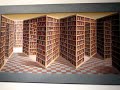
The "Paradoxymoron" 3D painting by Patrick Hughes - http://www.youtube.com/watch...
"One of Patrick Hughes’s many cool 3D paintings, “Paradoxymoron, currently hangs in the basement of the British Library, in London. Hughes’ work is full of irony. By creating a world solidified into perspective he makes pictures that come alive before our eyes. In the myth of the sculptor Pygmalion makes a stone woman, whom Aphrodite brings to life as Galatea. Hughes makes wooden lumps of space and you bring them to life by looking at them. It is sculpted painting, solid space." http://www.geeksaresexy.net/2010... See also Hughes' official website http://www.patrickhughes.co.uk/about... - Amira
André Rieu - 'And The Waltz Goes On' composed by Anthony Hopkins - http://www.youtube.com/watch...
André Rieu & His Johann Strauss Orchestra in Maastricht. - Amira
Winners of the National Geographic Traveler Photo Contest 2012 [Image: Ken Thorne] - http://www.theatlantic.com/infocus...
“Near the city of Morondava, on the West coast of Madagascar lies an ancient forest of Baobab trees. Unique to Madagascar, the endemic species is sacred to the Malagasy people, and rightly so. Walking amongst these giants is like nothing else on this planet. Some of the trees here are over a thousand years old. It is a spiritual place, almost magical.” - Amira
The Art of Fiction -- interview with Jorge Luis Borges, who would have been 113 today http://www.theparisreview.org/intervi...
"When I was a young man I was always hunting for new metaphors. Then I found out that really good metaphors are always the same. I mean you compare time to a road, death to sleeping, life to dreaming, and those are the great metaphors in literature because they correspond to something essential. If you invent metaphors, they are apt to be surprising during the fraction of a second, but they strike no deep emotion whatever. If you think of life as a dream, that is a thought, a thought that is real, or at least that most men are bound to have, no? “What oft was thought, but ne'er so well expressed.” I think that's better than the idea of shocking people, than finding connections between things that have never been connected before, because there is no real connection, so the whole thing is a kind of juggling." - Amira
"The ships hung in the sky in much the same way that bricks don't." #beautifulsimile #disorderedthoughtprocess :) - Eivind
"The certitude that everything has been written negates us or turns us into phantoms." -- The Library of Babel - Amira
DNA could have existed long before life itself | New Scientist - http://www.newscientist.com/article...
"The latest twist in the origin-of-life tale is double helical. Chemists are close to demonstrating that the building blocks of DNA can form spontaneously from chemicals thought to be present on the primordial Earth. If they succeed, their work would suggest that DNA could have predated the birth of lifeMovie Camera. DNA is essential to almost all life on Earth, yet most biologists think that life began with RNA. Just like DNA, it stores genetic information. What's more, RNA can fold into complex shapes that can clamp onto other molecules and speed up chemical reactions, just like a protein, and it is structurally simpler than DNA, so might be easier to make. After decades of trying, in 2009 researchers finally managed to generate RNA using chemicals that probably existed on the early Earth. Matthew Powner, now at University College London, and his colleagues synthesised two of the four nucleotides that make up RNA. Their achievement suggested that RNA may have formed spontaneously - powerful support for the idea that life began in an "RNA world". (...)" - Amira
"Nucleotides consist of a sugar attached to a phosphate and a nitrogen-containing base molecule - these bases are the familiar letters of the genetic code. DNA nucleotides, which link together to form DNA, are harder to make than RNA nucleotides, because DNA uses a different sugar that is tougher to work with. (....) That could have important implications for our understanding of life's origins. (...) Conventional wisdom is that RNA-based life eventually switched to DNA because DNA is better at storing information. In other words, RNA organisms made the first DNA. (...) Life may have begun with an "RNA and DNA world", in which the two types of nucleotides were intermingled. (...) Powner suggests that life started out using these hybrid molecules, gradually purifying them into DNA and RNA." - Amira
“Sometimes when I’m in a big important international meeting and you see me writings stuff down, it might be that I’m just drawing some, drawing some folks.” — Barack Obama http://www.washingtonpost.com/blogs...
Illustration: Barack Obama’s doodlings, one of which sold on E-bay in 2007 for $2075. - Amira
Christof Koch on The Nature of Consciousness: How the Internet Could Learn to Feel - http://aminotes.tumblr.com/post...
"It doesn't matter so much that you're made out of neurons and bones and muscles. Obviously, if we lose neurons in a stroke or in a degenerative disease like Alzheimer's, we lose consciousness. But in principle, what matters for consciousness is the fact that you have these incredibly complicated little machines, these little switching devices called nerve cells and synapses, and they're wired together in amazingly complicated ways. The Internet now already has a couple of billion nodes. Each node is a computer. Each one of these computers contains a couple of billion transistors, so it is in principle possible that the complexity of the Internet is such that it feels like something to be conscious. I mean, that's what it would be if the Internet as a whole has consciousness. Depending on the exact state of the transistors in the Internet, it might feel sad one day and happy another day, or whatever the equivalent is in Internet space. (...)" - Amira
"It's more difficult to ascertain what exactly it feels. But there's no question that in principle it could feel something. (...) Q: How do you define consciousness? Typically, it means having subjective states. (...) Consciousness is not easy to define, but don't worry too much about the definition. Otherwise, you get trapped in endless discussions about what exactly you mean. It's much more important to have a working definition, run with it, do experiments, and then modify it as necessary. (...) I see a universe that's conducive to the formation of stable molecules and to life. And I do believe complexity is associated with consciousness. Therefore, we seem to live in a universe that's particularly conducive to the emergence of consciousness. That's why I call myself a "romantic reductionist." - Amira
Why We Keep Getting the Same Old Ideas - http://www.creativitypost.com/create...
"Aoccdrnig to a rscheearch at Cmabridge Uinvervtisy, it deosnt mttaer in waht oredr the litteers in a wrod are, the olny iprmoetnt tihng is taht the frist and lsat ltteer be at the rghit pclae. The rset can be a ttoal mses and you can sitll raed it wouthit a porbelm. Tihs is besauae ocne we laren how to raed we bgien to aargnre the lteerts in our mnid to see waht we epxcet tp see. The huamn mnid deos not raed ervey lteter by istlef, but the wrod as a wlohe. We do tihs ucnsolniuscoy. (....) // When information enters the mind, it self-organizes into patterns and ruts much like the hot water on butter. New information automatically flows into the preformed grooves. After a while, the channels become so deep it takes only a bit of information to activate an entire channel. This is the pattern recognition and pattern completion process of the brain. Even if much of the information is out of the channel, the pattern will be activated. The mind automatically corrects and completes the information to select and activate a pattern.This is why you can read the jumbled letters above as words." - Amira
"This is also why when we sit down and try to will new ideas or solutions; we tend to keep coming up with the same-old, same-old ideas. Information is flowing down the same ruts and grooves making the same-old connections producing the same old ideas over and over again. Even tiny bits of information are enough to activate the same patterns over and over again. (...) How then can we change our thinking patterns? Think again about the dish of butter with all the preformed channels. Creativity occurs when we tilt the dish in a different direction and force the water (information) to create new channels and make new connections with other channels. These new connections give you different ways to focus your attention and different ways to interpret whatever you are focusing on. Nature gets variation with genetic mutations. Creative thinkers get variation by conceptually combining dissimilar subjects which changes our thinking patterns and provides us with a variety of alternatives and conjectures. (...)" - Amira
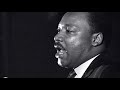
Unheard Martin Luther King Audio Found in Attic “I am convinced that when the history books are written in future years, historians will have to record this movement as one of the greatest epics of our heritage” [Dec. 21, 1960] - http://www.youtube.com/watch...
"A Tennessee man searching through his attic several months ago discovered a piece of American history: An audio reel of an unreleased interview with Dr. Martin Luther King conducted by his father for a book project that was never finished. (...) In clear audio, King discusses the importance of the civil rights movement, his definition of nonviolence and how a recent trip of his to Africa informed his views. (...) One historian said the newly discovered interview is unusual because there’s little audio of King discussing his activities in Africa. (...) During part of the interview, King defines nonviolence and justifies its practice. “I would … say that it is a method which seeks to secure a moral end through moral means,” he said. “And it grows out of the whole concept of love, because if one is truly nonviolent that person has a loving spirit, he refuses to inflict injury upon the opponent because he loves the opponent.” - Amira
"The interview was made four years before the Civil Rights Act became law, three years before King’s famous “I Have a Dream” speech, and eight years before his assassination. At one point in the interview, King predicts the impact of the civil rights movement. “I am convinced that when the history books are written in future years, historians will have to record this movement as one of the greatest epics of our heritage,” he said." http://www.jacksonsun.com/viewart... - Amira
How the Internet Affects Our Memories: Cognitive Consequences of Having Information at Our Fingertips [updated] - http://aminotes.tumblr.com/post...
Abstract: “The advent of the Internet, with sophisticated algorithmic search engines, has made accessing information as easy as lifting a finger. No longer do we have to make costly efforts to find the things we want. We can “Google” the old classmate, find articles online, or look up the actor who was on the tip of our tongue. The results of four studies suggest that when faced with difficult questions, people are primed to think about computers and that when people expect to have future access to information, they have lower rates of recall of the information itself and enhanced recall instead for where to access it. The Internet has become a primary form of external or transactive memory, where information is stored collectively outside ourselves.” - Amira
Using tools directs our evoluation, surely. - avatar8
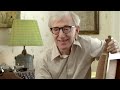
12 Questions for Woody Allen - http://www.youtube.com/watch...
"Filmmaker Robert Weide, seen quizzing Woody Allen in this clip, followed the notoriously private film legend for over a year to create the ultimate film biography. Iconic writer, director, actor, comedian, and musician Woody Allen allows his life and creative process to be documented on-camera for the first time." A documentary trailer: http://www.lovefilm.se/film... - Amira
"I knew he wasn't a man who embraced technology, but he’s literally had the same typewriter since he was 16. Every professional word he’s written in his life was on this one typewriter. "And he doesn’t have an office. He has this little desk in the corner of his bedroom, with a little World War II surplus lamp he turns on. And that's where he creates." (...) "Because his films are so cheap, he’ll always make a few bucks, so he’s got a queue of people lining up to work with him. "He can make whatever he wants. Whether or not it does well at the box office, by the time it’s out, he’s making his next film. He’s totally his own man." http://www.huffingtonpost.co.uk/2012... - Amira
What was daily life like before almost everyone had cell phones? "You left the house and you were gone." | Quora - http://www.quora.com/Mobile-...
"If you got separated from a friend at an event, you might simply never hear from them again until you were both home and called each other. At home, most phones weren't even cordless. You had to stand within 6 feet of the wall. A popular item was super long phone cords. (...) When I was a much younger man, I spent five months backpacking around east Africa. (...) They had no idea I was coming back, and I can still remember the look on my stepdad's face when he opened the door shortly after dawn to see me standing there, probably the worse for wear, but the better for the experiences I had had. I remember him yelling up the stairs "He's home!!" and my Mom charging down in her bathrobe to greet me and hear about my adventures. (...) No kid today is ever going to have that experience. (...) // Actually, it was utopia. You could actually walk out the door and not be bothered by your boss, your spouse, your attorney, your kids, your parents, your siblings, your bill collectors... (...)" - Amira
Those still are the days. Just quit doing everything with a phone on all the time. - m9m, Crone of FriendFeed
Surreal photography by Gilbert Garcin [Flash Back, 2001 and L’attraction du vide, 2001] http://www.gilbert-garcin.com/
"Gilbert Garcin was originally the owner of a lamp manufacturing company in Marseille, France. Following a workshop during the Rencontres Internationales in Arles, under the direction of Pascal Dolemieux, Garcin, at the age of 65, gave up his business and began his photographic career. His work has been exhibited and collected around the globe, which satisfies his goal of sharing his ideas on life and his perspective on the world with the public at large. In his photographs, Garcin poses as an ordinary 'Mr. Everybody,' dressed in an old overcoat. By placing himself, via the character he embodies, in absurd and inextricable situations, he invites us to ponder such philosophical quandaries as time, solitude and the weight of existence. Over the past fifteen years, Garcin has published four books and has had numerous international exhibitions. In 2009, he celebrated his 80th birthday with a traveling "Retrospective" exhibition." http://www.fotofest.org/exhibit... - Amira
The Human Condition by René Magritte (1933) “We are surrounded by curtains. We only perceive the world behind a curtain of semblance. At the same time, an object needs to be covered in order to be recognized at all.” http://aminotes.tumblr.com/post...
René Magritte in his letter to A. Chavee said about the painting: "...Questions such as ‘What does this picture mean, what does it represent?’ are possible only if one is incapable of seeing a picture in all its truth, only if one automaically understands that a very precise image does not show precisely what it is. It’s like believing that the implied meaning (if there is one?) is worth more than the overt meaning. (…) How can anyone enjoy interpreting symbols? They are ‘substitutes’ that are only useful to a mind that is incapable of knowing the things themselves. A devotee of interpretation cannot see a bird; he only sees it as a symbol. Although this manner of knowing the ‘world’ may be useful in treating mental illness, it would be silly to confuse it with a mind that can be applied to any kind of thinking at all.” - Amira
“Magritte was heavily influenced by the writings of Immanuel Kant, who proposed that humans can rationalize situations but can not comprehend the “things-in-themselves.” As it applies to Magritte’s work, he is simply creating a variation upon his over-arching philosophy: A painting of a scene is not the same as a scene. “Ceci n’est pas une pipe.” Magritte plays with this philosophy by exploiting the flatness of two-dimensional space in his painting by depicting three-dimensional space outside and a two-dimensional painting that have the same imagery. The title refers to the inherent grappling that all humans go through when viewing his mind-bending painting.” - Amira
“If one looks at a thing with the intention of trying to discover what it means, one ends up no longer seeing the thing itself, but thinking of the question that has been raised. The mind sees in two different senses: (1) sees, as with the eyes; and (2) sees a question (no eyes).” — René Magritte - Amira
My latest Flickr favorites http://www.flickr.com/photos...
How do you do that? - Melly #FForever
You can do it with a screen shot, Melly :) - Eivind
Horse - Full of energy - http://www.flickr.com/photos...
“Pi In The Sky” Fantastic Art and Science Kickstarter project | Imaginary Foundation - http://blog.imaginaryfoundation.com/2012...
"Pi In The Sky The world’s largest ephemeral installation is scheduled to appear in the sky above the San Francisco between Sept. 12 and 16. It will display 1000 digits of Pi a 1/4 mile high each." Merging art and technology, ISHKY has brought together a team of artists, programmers and scientists to give life to a compelling vision that a community of millions will directly experience. The conceptual work, Pi In The Sky, explores the boundaries of scale, public space, impermanence, and the relationship between Earth and the physical universe. Your generosity will set this momentous and historic undertaking in motion. (...) Pi In The Sky has two unique interpretations, one within Earth's atmosphere and one well beyond it: At 10,000 feet altitude working with our technical partner AirSign, a team of five synchronized aircraft equipped with dot-matrix technology will skywrite the first 1,000 numbers of pi's infinite sequence in a 100-plus-mile loop around the San Francisco Bay Area. Each number will measure over a quarter-mile in height." http://www.kickstarter.com/project... - Amira
Search technology that can gauge opinion and predict the future http://www.sciencedaily.com/release...
"Inspired by a system for categorising books proposed by an Indian librarian more than 50 years ago, a team of EU-funded researchers have developed a new kind of internet search that takes into account factors such as opinion, bias, context, time and location. The new technology, which could soon be in use commercially, can display trends in public opinion about a topic, company or person over time -- and it can even be used to predict the future. (...) A pioneering combination of modern science and a decades-old classification method, brought together by European researchers in the LivingKnowledge project. Supported by EUR 4.8 million in funding from the European Commission, the LivingKnowledge team, coordinated by Prof. Giunchiglia, adopted a multidisciplinary approach to developing new search technology, drawing on fields as diverse as computer science, social science, semiotics and library science. (...) We were able to turn Ranganathan's pseudo-algorithm into a computer algorithm and the computer scientists were able to use it to mine data from the web, extract its meaning and context, assign facets to it, and use these to structure the information based on the dimensions of diversity. (...)" - Amira
"Researchers at the University of Pavia in Italy, another partner, drew on their expertise in extracting meaning from web content -- not just from text and multimedia content, but also from the way the information is structured and laid out -- in order to infer bias and opinions, adding another facet to the data. 'We are able to identify the bias of authors on a certain subject and whether their opinions are positive or negative,' the LivingKnowledge coordinator says. 'Facts are facts, but any information about an event, or on any subject, is often surrounded by opinions and bias.' (...) More immediately, this application scenario provides functionality for detecting trends even before these trends become apparent in daily events -- based on integrated search and navigation capabilities for finding diverse, multi-dimensional information depending on content, bias and time,' (...) 'The future will be all about big data -- we can't say whether it will be good or bad, but it will certainly be different.'" - Amira
Facts are facts? lol - Meg VMeg
Book written in DNA code. Scientists who encoded the book say it could soon be cheaper to store information in DNA than in conventional digital devices - http://www.guardian.co.uk/science...
"Scientists have for the first time used DNA to encode the contents of a book. At 53,000 words, and including 11 images and a computer program, it is the largest amount of data yet stored artificially using the genetic material. The researchers claim that the cost of DNA coding is dropping so quickly that within five to 10 years it could be cheaper to store information using this method than in conventional digital devices. Deoxyribonucleic acid or DNA – the chemical that stores genetic instructions in almost all known organisms – has an impressive data capacity. One gram can store up to 455bn gigabytes: the contents of more than 100bn DVDs, making it the ultimate in compact storage media. A three-strong team led by Professor George Church of Harvard Medical School has now demonstrated that the technology to store data in DNA, while still slow, is becoming more practical. They report in the journal Science that the 5.27 megabit collection of data they stored is more than 600 times bigger than the largest dataset previously encoded this way. (...)" - Amira
"DNA has numerous advantages over traditional digital storage media. It can be easily copied, and is often still readable after thousands of years in non-ideal conditions." Digital data is traditionally stored as binary code: ones and zeros. Although DNA offers the ability to use four "numbers": A, C, G and T, to minimise errors Church's team decided to stick with binary encoding, with A and C both indicating zero, and G and T representing one. The sequence of the artificial DNA was built up letter by letter using existing methods with the string of As, Cs, Ts and Gs coding for the letters of the book. The team developed a system in which an inkjet printer embeds short fragments of that artificially synthesised DNA onto a glass chip. Each DNA fragment also contains a digital address code that denotes its location within the original file. The fragments on the chip can later be "read" using standard techniques of the sort used to decipher the sequence of ancient DNA found in archeological material. A computer can then reassemble the original file in the right order using the address codes." - Amira
Next-Generation Digital Information Storage in DNA by G. M. Church, Y. Gao, S. Kosuri http://www.sciencemag.org/content... - Amira
Reality - Wikipedia, the free encyclopedia http://en.wikipedia.org/wiki...
"In philosophy, reality has become a commodity. In a wider definition, reality includes everything that is and has been, whether or not it is observable or comprehensible. A still more broad definition includes everything that has existed, exists, or will exist. (...) Western philosophy addresses two different aspects of the topic of reality: the nature of reality itself, and the relationship between the mind (as well as language and culture) and reality. (...) Perception: The question of direct or "naïve" realism, as opposed to indirect or "representational" realism, arises in the philosophy of perception and of mind out of the debate over the nature of conscious experience; the epistemological question of whether the world we see around us is the real world itself or merely an internal perceptual copy of that world generated by neural processes in our brain. Naïve realism is known as direct realism when developed to counter indirect or representative realism, also known as epistemological dualism, the philosophical position that our conscious experience is not of the real world itself but of an internal representation, a miniature virtual-reality replica of the world. (...)" - Amira
Phenomenological reality: "On a much broader and more subjective level, private experiences, curiosity, inquiry, and the selectivity involved in personal interpretation of events shapes reality as seen by one and only one individual and hence is called phenomenological. While this form of reality might be common to others as well, it could at times also be so unique to oneself as to never be experienced or agreed upon by anyone else. (...) The word phenomenology comes from the Greek phainómenon, meaning "that which appears", and lógos, meaning "study". In Husserl's conception, phenomenology is primarily concerned with making the structures of consciousness, and the phenomena which appear in acts of consciousness, objects of systematic reflection and analysis. Such reflection was to take place from a highly modified "first person" viewpoint, studying phenomena not as they appear to "my" consciousness, but to any consciousness whatsoever. Husserl believed that phenomenology could thus provide a firm basis for all human knowledge, including scientific knowledge, and could establish philosophy as a "rigorous science"." - Amira
Study shows how computation can predict group conflict - http://phys.org/news...
"When conflict breaks out in social groups, individuals make strategic decisions about how to behave based on their understanding of alliances and feuds in the group. (...) In a new study, scientists at the Wisconsin Institute for Discovery (WID) at the University of Wisconsin-Madison develop a computational approach to determine whether individuals behave predictably. With data from previous fights, the team looked at how much memory individuals in the group would need to make predictions themselves. The analysis proposes a novel estimate of "cognitive burden," or the minimal amount of information an organism needs to remember to make a prediction. The research draws from a concept called "sparse coding," or the brain's tendency to use fewer visual details and a small number of neurons to stow an image or scene. Previous studies support the idea that neurons in the brain react to a few large details such as the lines, edges and orientations within images rather than many smaller details. (...)" - Amira
"What is the trade-off? What's the minimum amount of 'stuff' an individual has to remember to make good inferences about future events?" (...) By recording individuals' involvement -- or lack thereof -- in fights, the group created models that mapped the likelihood any number of individuals would engage in conflict in hypothetical situations. (...) Since the statistical modeling and computation frameworks can be applied to different natural datasets, the research has the potential to influence other fields of study, including behavioral science, cognition, computation, game theory and machine learning. Such models might also be useful in studying collective behaviors in other complex systems, ranging from neurons to bird flocks. Future research will seek to find out how individuals' knowledge of alliances and feuds fine-tunes their own decisions and change the groups' collective pattern of conflict." - Amira
Patrice Normand – Ateliers - http://www.mydesy.com/patrice...
"Atelier is the French word for “workshop”, and in English is used principally for the workshop of an artist in the fine or decorative arts. This is what the book presented below called “Ateliers” is based on by TempMachine and photographers Patrice Normand, Vincent Leroux, and Yannick Labrousse. Commissioned by the city of Saint-Ouen (Seine-Saint-Denis) art studios, they took photographs of artists’ studios located in the territory of the city. Patrice Normand accentuates the gesture of creation by revealing a choreographic series, Vincent analyses the relation between the artist and his own place of creation. Finally Yannick deals with the disappearance of the artist and with the appearance of the work of art." http://the189.com/photogr... - Amira
An algorithm for tracking viruses (and Twitter rumors) to their source - http://gigaom.com/data...
"A team of Swiss researchers thinks it has created an algorithm capable of tracking almost anything -- from computer viruses to terrorist attacks to epidemics -- back to the source using a minimal amount of data. The trick is focusing on time to figure out who “infected” whom. No, Vanilla Ice isn’t dead — and if he had access to a new algorithm from Swiss researcher Pedro Pinto, the Ice Man could go all techno-ninja and track down who started the rumor claiming he was. That’s because Pinto and his colleagues at the Ecole Polytechnique Fédérale de Lausanne have developed an algorithm for finding the source of such rumors, as well as viruses (physical and digital) and other maladies, even across highly complex networks. Their method, according to an abstract of a paper just published in Physical Review Letters, is ideal for situations where there is relatively little data to work with, and is “based on the principles used by telecommunication towers to pinpoint cell phone users.” Essentially, the algorithm starts by looking at a small collection of points within a network and working back from there to determine the origin, kind of like how investigators can zero in on a cell phone’s location using triangulation. The more connections, or observers, a particular point has, the fewer that are needed to track down the source point." - Amira
tracked down the original source :-) http://prl.aps.org/abstrac... - Adriano